
Improve Battery Performance with Intelligent Active Cell Balancing
Our Active Balancing BMS (Battery Management System) is designed for lithium battery packs requiring efficient cell balancing, reliable battery protection, and intelligent monitoring.
Unlike traditional passive balancing, an active cell balancing BMS redistributes energy between battery cells instead of simply dissipating excess energy as heat. This helps reduce cell voltage differences, improve usable battery capacity, and support more efficient battery operation.
Designed for battery pack manufacturers, BMS wholesalers, distributors, and energy storage system integrators, our active balancing BMS solutions can be tailored to different battery configurations and application requirements.
Benefits: Business Value for Battery Manufacturers and Distributors
For Battery Pack Manufacturers
For battery pack manufacturers, selecting the right active balancing lithium battery BMS can deliver several practical benefits:
- Improve usable battery capacity by minimizing cell imbalance.
- Reduce unnecessary energy loss during battery balancing.
- Support consistent battery pack performance throughout repeated charge and discharge cycles.
- Simplify integration with compatible battery monitoring and energy management systems.
- Support product differentiation through intelligent battery management features.
For Distributors & Wholesalers
For BMS distributors and wholesalers, flexible product configurations can help serve multiple customer segments and simplify procurement across different battery applications.
Our goal is to help B2B customers find the right balance between product performance, technical compatibility, project requirements, and purchasing costs.
Key Features: Intelligent Active Cell Balancing
Our Active Balancing BMS solutions focus on the following capabilities, depending on the selected model and configuration:
Active Cell Balancing
Redistributes energy between cells to reduce voltage differences and improve pack-level energy utilization.
Intelligent Battery Protection
Supports overcharge, over-discharge, overcurrent, short-circuit, and temperature protection.
Real-Time Battery Monitoring
Monitors cell voltage, battery temperature, current, and operating status.
Flexible Battery Configurations: Solutions can be selected for different lithium battery cell counts, voltage ranges, and current requirements.
These features make an active balancing BMS for LiFePO4 battery packs particularly suitable for applications involving high-capacity batteries and demanding operating conditions.
Communication & Integration
Smart Communication: Selected models support Bluetooth, CAN bus, RS485, and UART communication for battery monitoring and system integration.
Advantages: Why Choose an Active Balancing BMS?
More Efficient Energy Management. Compared with conventional passive balancing, active balancing transfers energy between cells, reducing the energy wasted as heat during the balancing process.
Improved Cell Voltage Consistency. By reducing voltage differences between cells, intelligent active balancing helps minimize the impact of cell imbalance on battery pack performance.
Better Support for High-Capacity Battery Packs. Active balancing is especially valuable for high-capacity LiFePO4 battery packs, where conventional passive balancing may require significantly longer balancing times.
Flexible System Integration. Depending on the model, configurable parameters and communication interfaces help battery manufacturers integrate the BMS into different battery pack designs.
Applications: Active Balancing BMS Solutions
Our active balancing BMS solutions are intended for applications such as:

Solar Energy Storage
Active balancing BMS for solar battery storage and off-grid LiFePO4 battery systems.

Residential Energy Storage
Intelligent BMS solutions for home energy storage battery packs.
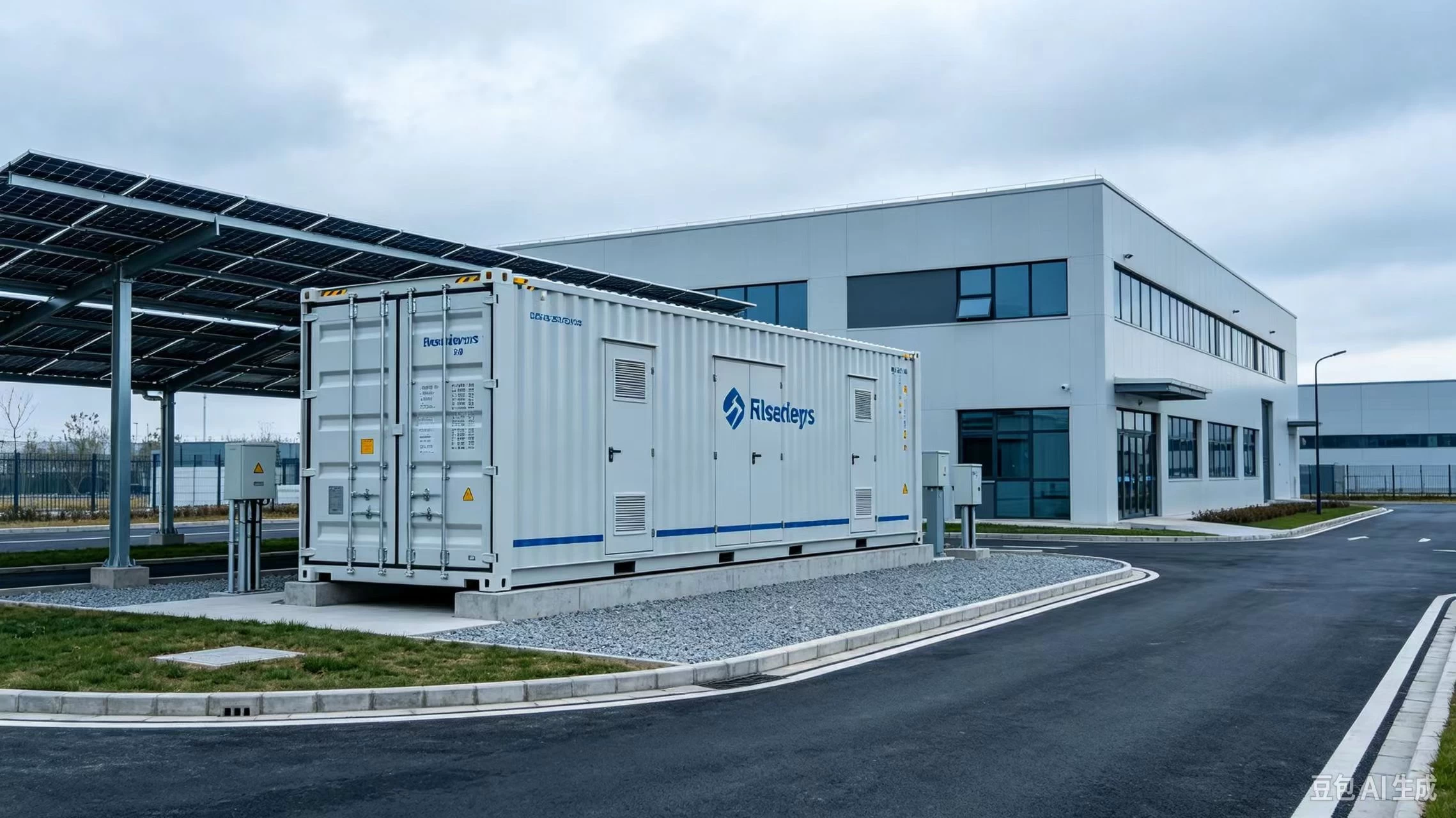
Commercial Energy Storage
Battery management solutions for compatible commercial battery storage applications.
RV and Marine Batteries: Active balancing solutions for high-capacity lithium battery packs.
Industrial Battery Systems: Battery management solutions for industrial lithium battery applications.
OEM / ODM BMS Customization
OEM/ODM Customization: Available options may include customized protection parameters, communication protocols, balancing configurations, and battery pack integration.
BMS Selection Details
For customers sourcing a 16S 48V LiFePO4 active balancing BMS, or other configurations, model selection should be based on battery specifications and actual application requirements.
Frequently Asked Questions
What is the difference between active balancing and passive balancing BMS?
Active balancing transfers energy between battery cells, while passive balancing dissipates excess energy through resistors. Active balancing can offer greater energy efficiency and faster balancing for suitable high-capacity battery applications, although it generally involves greater circuit complexity and cost.
How do I choose the right active balancing BMS for my LiFePO4 battery pack?
Consider your battery cell count, nominal voltage, capacity, maximum charge and discharge current, required balancing current, communication protocol, and installation environment. The correct configuration depends on your battery design and operating conditions.
Find Your Ideal Active Balancing BMS Supplier
Looking for an OEM active balancing BMS supplier, wholesale LiFePO4 BMS solution, or customized active cell balancing battery management system?
Tell us your battery specifications, application, and estimated order quantity.
Contact Us — Get Technical Support & Request a BMS Quotation.
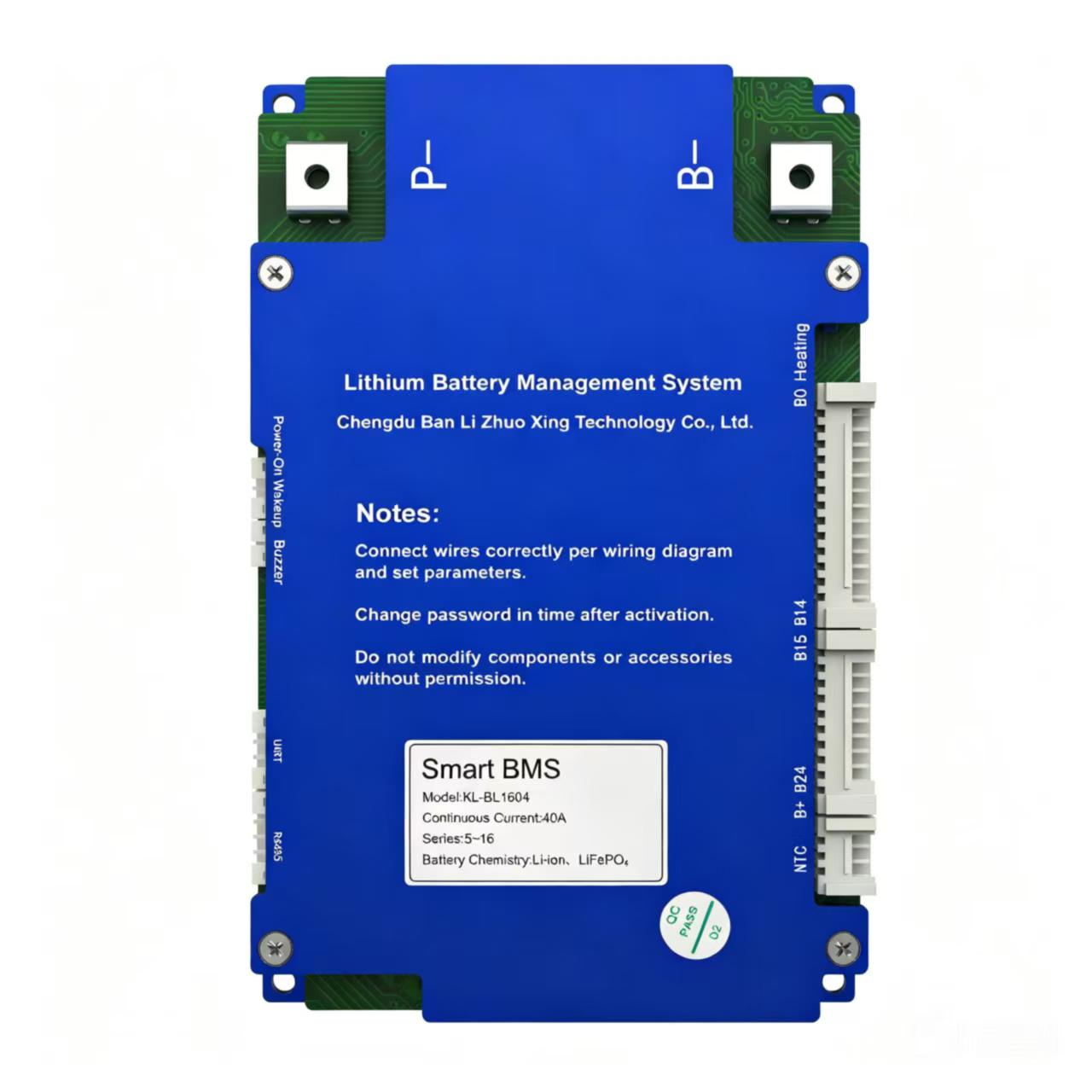
5–16S 40A — Specification
| Product Introduction | ||
| Model | BL1604 | |
| Cell Series (S) | 5-16S | |
| Applicable battery | LiFePO4, NCM & LTO | |
| Continuous discharge current | 40A | |
| Basic Functions | Size | 127*80*14.6mm |
| BMS Offline Protection | Equipped | |
| Enclosure Design | Weatherproof Design – PCB with Conformal Coating | |
| Overcurrent Solution | MOS | |
| Modular Expandable Design | Integrated | |
| SOC Tracking | Coulomb Counter (Drift <3%) | |
| Charging Method | Same Port | |
| Communication | UART, RS485,Bluetooth | |
| Secondary Overvoltage Protection | Equipped | |
| Precise monitoring and balancing | Full-Time Automatic Balancing | |
| Thermal Runaway Pre-Warning | Multi-layer redundancy + gas/impedance monitoring, alerts before failure | |
| Other Functions | Alarm Functions | |
| Multiple sleep and wake-up methods. | ||
| Voltage/Cell/MOS temperature/Short circuit detection | ||
| Current integration function | ||
| etc | ||
| Software | APP/Host Computer/IoT Cloud Platform | |
| Optional Features | Communication | CAN, Isolated RS-485, LTE, 4G/5G |
| Remote Positioning | GPS / BDS (BeiDou Navigation Satellite System) | |
| Smart Handshake | Automatic Inverter Handshake Protocol | |
| Low Temperature Charging | Heater Port Ready (Charges at -45°C to +75℃) | |
| Connection Safety | Anti-Spark (Pre-charge Resistor) | |
| Regenerative Braking | Downhill Regeneration Protection | |
| Cloud-based Remote Calibration & Management | Real-time Data Control & Monitoring | Remote Charge/Discharge Control |
| Battery Abnormality Alert | ||
| Low Battery Warning | ||
| Voltage & SOC & Cycle Count | ||
| Cell Temperature & PCB / MOS Temp | ||
| Real-time GPS Tracking | Remote monitoring of battery operational status | |
| OTA | Remote OTA update for the BMS & Communication module | |
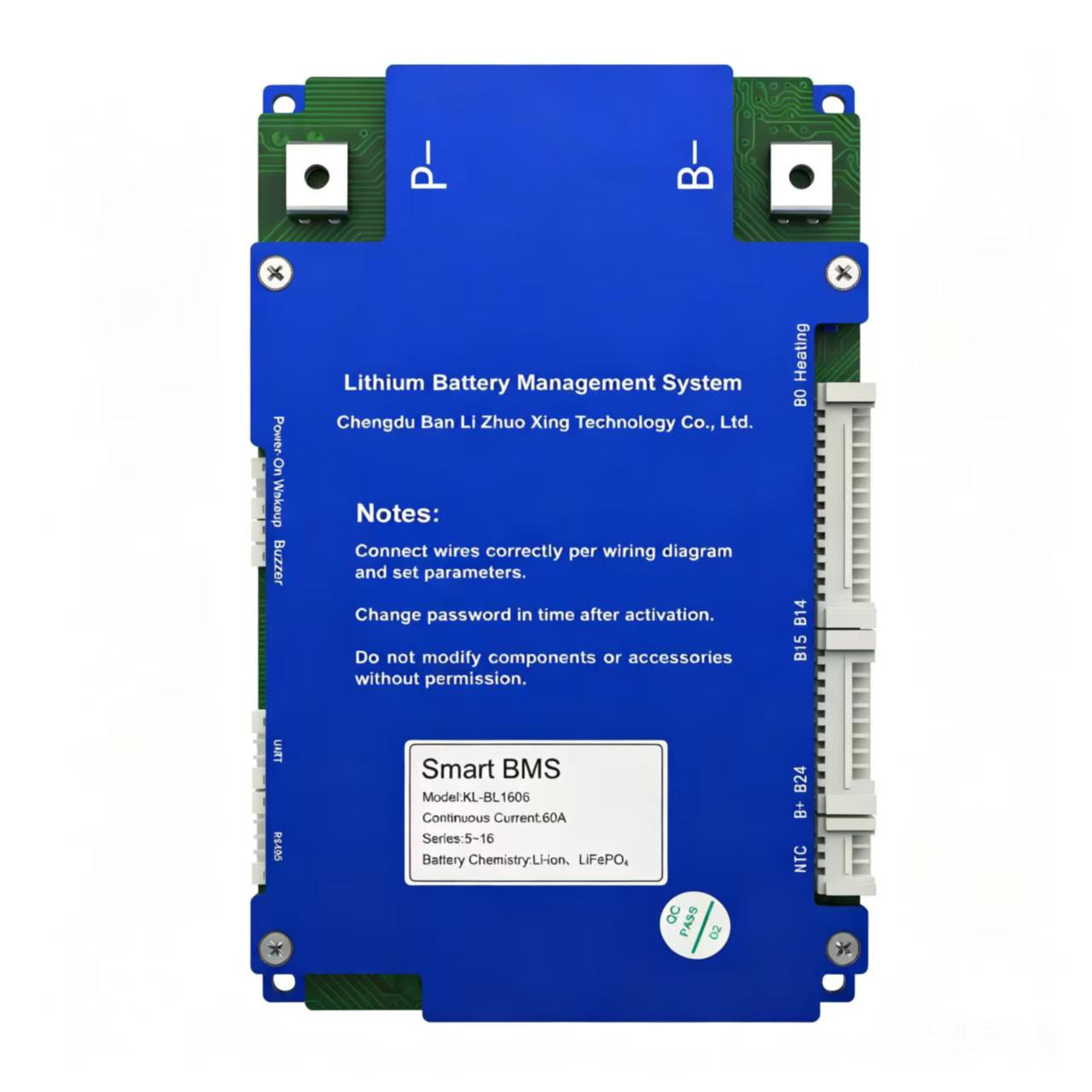
5–16S 60A — Specification
| Product Introduction | ||
| Model | BL1606 | |
| Cell Series (S) | 5-16S | |
| Applicable battery | LiFePO4, NCM & LTO | |
| Continuous discharge current | 60A | |
| Basic Functions | Size | 127*80*14.6mm |
| BMS Offline Protection | Equipped | |
| Enclosure Design | Weatherproof Design – PCB with Conformal Coating | |
| Overcurrent Solution | MOS | |
| Modular Expandable Design | Integrated | |
| SOC Tracking | Coulomb Counter (Drift <3%) | |
| Charging Method | Same Port | |
| Communication | UART, RS485,Bluetooth | |
| Secondary Overvoltage Protection | Equipped | |
| Precise monitoring and balancing | Full-Time Automatic Balancing | |
| Thermal Runaway Pre-Warning | Multi-layer redundancy + gas/impedance monitoring, alerts before failure | |
| Other Functions | Alarm Functions | |
| Multiple sleep and wake-up methods. | ||
| Voltage/Cell/MOS temperature/Short circuit detection | ||
| Current integration function | ||
| etc | ||
| Software | APP/Host Computer/IoT Cloud Platform | |
| Optional Features | Communication | CAN, Isolated RS-485, LTE, 4G/5G |
| Remote Positioning | GPS / BDS (BeiDou Navigation Satellite System) | |
| Smart Handshake | Automatic Inverter Handshake Protocol | |
| Low Temperature Charging | Heater Port Ready (Charges at -45°C to +75℃) | |
| Connection Safety | Anti-Spark (Pre-charge Resistor) | |
| Regenerative Braking | Downhill Regeneration Protection | |
| Cloud-based Remote Calibration & Management | Real-time Data Control & Monitoring | Remote Charge/Discharge Control |
| Battery Abnormality Alert | ||
| Low Battery Warning | ||
| Voltage & SOC & Cycle Count | ||
| Cell Temperature & PCB / MOS Temp | ||
| Real-time GPS Tracking | Remote monitoring of battery operational status | |
| OTA | Remote OTA update for the BMS & Communication module | |