Battery packs are often described with an S/P label such as 4S2P. This shorthand matters because it describes how cells are grouped and helps determine the monitoring connections a BMS needs. It is only the first step in specifying a compatible BMS; chemistry, current, wiring, and system requirements also matter.
In this guide: S and P · A 4S2P example · Matching the BMS · Project checklist
What do S and P mean?
S means series. Series-connected cell groups add voltage. The number before S tells you how many groups are connected in series. A BMS designed for a multi-series pack needs to monitor the voltage of each series group.
P means parallel. Cells connected in parallel form a group that shares a common voltage. Adding cells in parallel increases group capacity and can change the available current, subject to the cells and pack design. The number before P tells you how many cells are in each parallel group.
What does 4S2P describe?
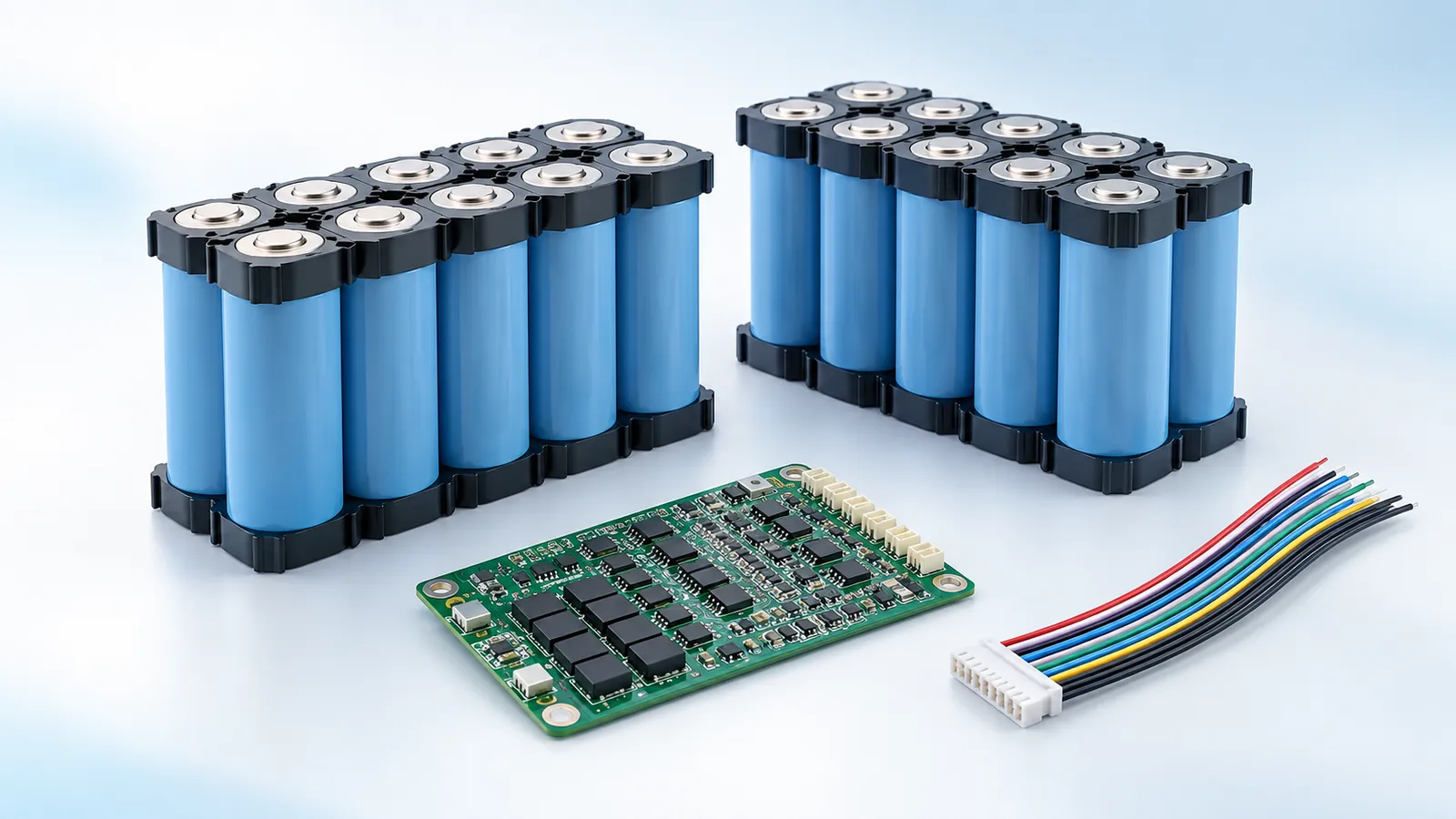
A 4S2P pack has four groups connected in series, with two cells connected in parallel within each group. That is eight cells in total. The BMS must be suitable for four series groups, but the S/P label alone does not establish the correct voltage limits, current rating, connectors, or charge strategy.
Cells within a parallel group should be selected and assembled under an appropriate pack-design process. The BMS normally observes each series group through a balance or sensing harness; it does not individually measure every cell in a parallel group unless the system is specifically designed to do so.
How does the S-count affect BMS selection?
The BMS sensing range and harness arrangement must match the number of series groups. A board intended for one S-count should not be assumed compatible with another. The connector pinout and installation sequence are also model-specific, so the approved wiring documentation is essential.
Chemistry matters just as much. LiFePO4 and other lithium-ion chemistries use different operating limits, and the correct settings must follow the cell manufacturer's data. Pack current, charger behavior, temperature sensing, and the application's fault-response requirements also influence the choice.
A practical checklist for B2B projects
- Identify the cell chemistry and the exact S/P configuration.
- Provide cell capacity, pack capacity, continuous current, and expected peak current.
- Specify the charger, load, and operating temperature conditions.
- Confirm communication needs, connector style, harness length, and mounting space.
- Ask for the model-specific wiring diagram and validate the assembled pack before production use.
Our Smart BMS and Energy Storage BMS pages outline solution families for different applications. For a specific pack, send us the configuration and project requirements.
Frequently asked questions
Does 4S2P mean a 4-cell BMS or an 8-cell BMS?
It means four series groups with two cells in each parallel group. The BMS series-channel requirement follows the four series groups, while the electrical ratings must suit the whole pack.
Can I choose a BMS from S-count alone?
No. Chemistry, current, protection behavior, harness pinout, and system integration must also match.
Technical reading: Texas Instruments: series-cell count and pack-capacity configuration.