
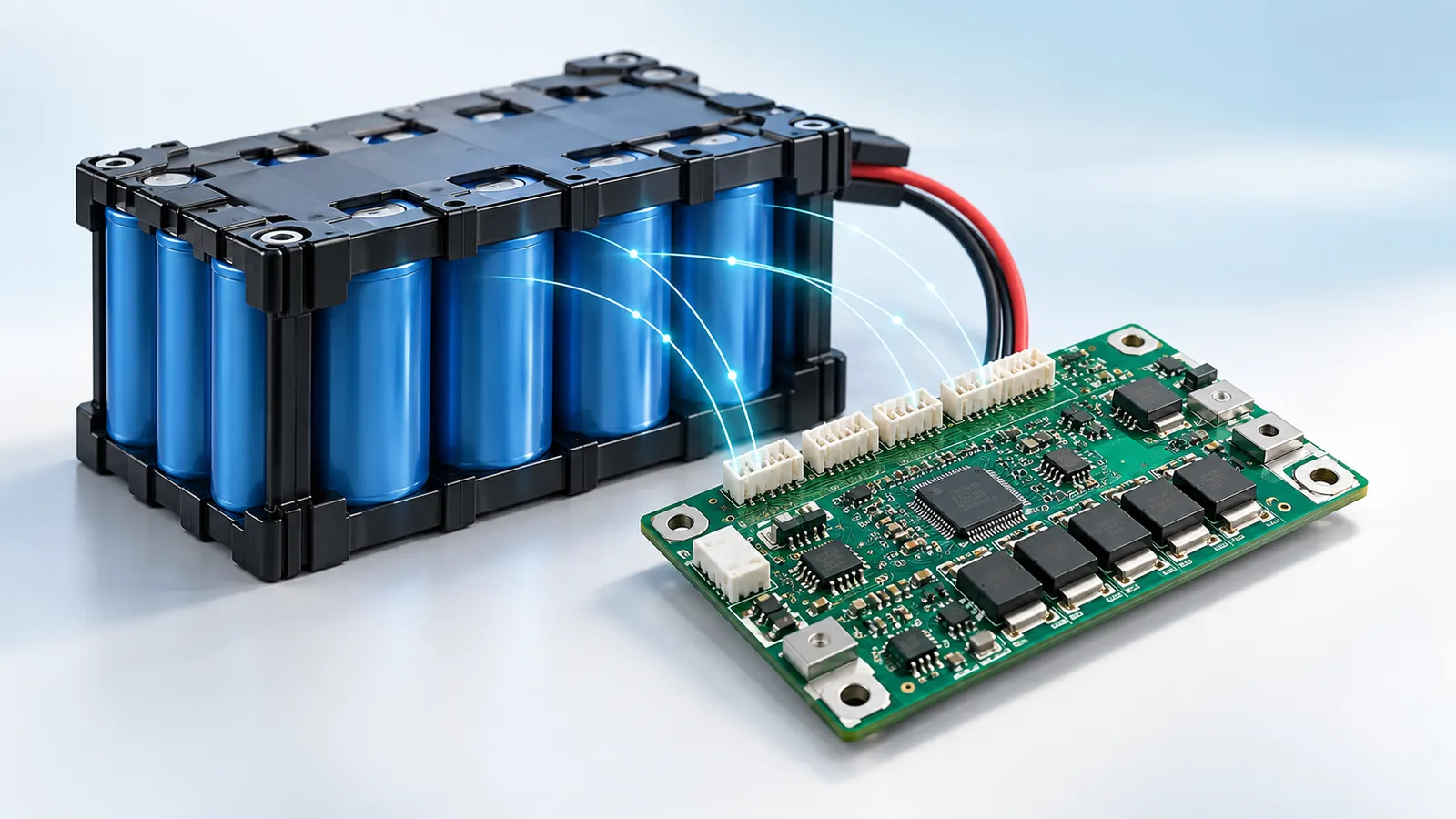
A battery management system (BMS) is the electronic control layer that helps a rechargeable lithium battery pack operate within its intended limits. It observes the pack, responds to abnormal conditions, and, when supported, shares operating data with the rest of the system. For a buyer or battery-pack designer, understanding these jobs is the starting point for choosing the right BMS.
In this guide: Monitoring · Protection · Communication · What to specify
What does a BMS monitor?
A BMS can measure individual series-group voltages, overall pack voltage, current, and temperature. Those measurements show whether the battery is operating as expected and provide inputs for protection decisions. Some systems also estimate state of charge (SOC), which is an estimate of remaining charge rather than a direct measurement.
Monitoring depth varies by product. A basic protection board may expose little data, while a smart BMS may report status to a display, mobile app, inverter, charger, or supervisory controller. Measurement features should be checked against the specific model and application.
How does a BMS protect the pack?
The BMS compares measurements with limits selected for the cells and pack. If it detects a condition such as cell overvoltage, cell undervoltage, excessive current, a short circuit, or temperature outside the allowed range, it can interrupt charging or discharging, issue a fault, or ask another system component to respond. The exact response depends on the BMS architecture.
- Voltage protection helps prevent cells from being charged too far or discharged too deeply.
- Current and short-circuit protection helps respond to abnormal electrical loads.
- Temperature monitoring helps keep charging and discharging within the cell maker's allowed conditions.
A BMS does not replace a compatible charger, appropriate cell selection, sound wiring, fusing, or pack-level validation. These parts work together as a battery system.
Why do some BMS designs include communication?
Communication gives other equipment access to battery status and faults. Depending on the model, interfaces may include Bluetooth, UART, RS485, or CAN. The useful question is not simply whether a port is present: the BMS, inverter, charger, or host controller must also use compatible wiring, message formats, and operating rules.
For projects that need monitoring or integration, see our Smart BMS solutions. For stationary battery projects, see Energy Storage BMS.
What should a buyer specify first?
Start with battery chemistry, series configuration, capacity, continuous and peak current, charge and discharge conditions, temperature environment, and required communications. Then confirm physical dimensions, connector and harness requirements, and any balancing or customization needs. These details determine whether a candidate BMS fits the pack; a product name alone does not.
If you are comparing options for a production project, share your battery requirements so the BMS can be matched to the actual cells and application.
Frequently asked questions
Is a BMS the same as a charger?
No. A charger supplies the appropriate charging profile; the BMS monitors and protects the battery pack and may communicate limits or status to compatible equipment.
Does every BMS provide SOC or Bluetooth?
No. Monitoring, estimated SOC, wireless access, and external communications depend on the specific hardware and firmware.
Technical reading: Texas Instruments: energy storage BMS design resources.